Lonely Teams Don't Innovate: What the 2025 Data Tells Us
“How often do you feel lonely while working?”
The answer to how 141,444 people answered this question was added to one of my Christmas in April gifts.
That’s right! My two faves dropped last month:
- Gallup’s State of the Global Workplace AND
- The Fearless Organization Scan’s The Fearless Report: The Global State of Psychological Safety at Work, 2025 Edition
(See Resources below).
What a time to be alive, have a pattern-matching brain, and be both a psychological safety practitioner and therapist. This edition of my newsletter is the topic of workplace loneliness in conversation with these two reports and what I’m seeing in my own therapy and coaching practices. Some data. Some observations.
Gallup’s Workplace Loneliness Findings
First let’s start with the data coming out of my region, the US and Canada. From 2024 to 2025 loneliness rose from 15% to 19%. This seems to be a newer measurement item and as such we have this info for the first time…
The Gender Gap Nobody’s Talking About
According to Gallup, women in the US and Canada report a 2% higher rate of loneliness than men.*
Does that surprise you? I did a little digging and it seems that, in general, loneliness shows up fairly evenly across gender in recent studies, but I find it fascinating that we’re not talking about a “female loneliness epidemic.”
*I can’t wait for a day where we have enough data to move beyond looking at trends on a gender binary, but it seems we’re not there yet.
Impact of Loneliness on Psychological Safety
OK, now let’s dive into one of my favorite topics, one I stopped saying so loudly because of the society we’re currently living in … psychological safety.
For those of you who missed class, psychological safety is defined by Amy Edmonson as “a belief that one will not be punished or humiliated for speaking up with ideas, questions, concerns, or mistakes” and it’s the key ingredient of the highest performing teams.
In this year’s Fearless Report, they collected responses to a loneliness question for the first time, thanks to the great work of Connie Hadley and Sarah Wright. Possibly one of the most alarming number to me is that 1 in 25 people reported being always lonely at work.
People who report having the highest levels of work loneliness feel also rated this item lowest: “members of this team are able to bring up problems and tough issues.”
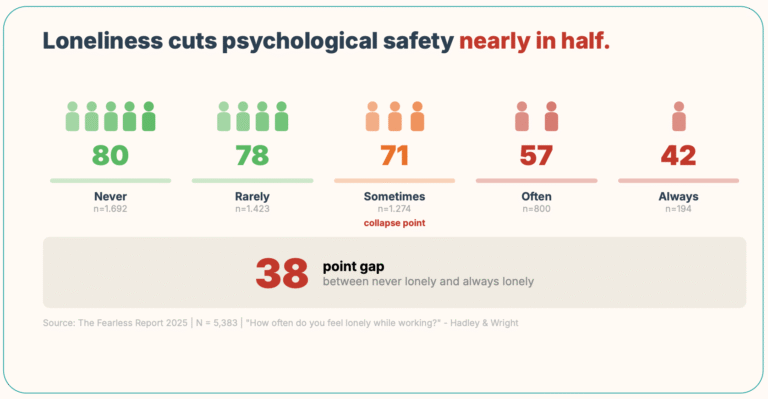
This item is the most closely tied with a sense of belonging AND the cornerstone of psychologically safe teams. If people don’t feel safe to share ideas or concerns, at best companies are missing out on potential innovations and at worst are increasing risks to physical safety, compliance, and profit loss.
Another interesting finding was that, in general, people tend to find higher levels of psychological safety on their teams when compared to the larger organization, but this isn’t so for the high loneliness group.
The Human Face of the Data
The reduction in psychological safety and the increase of loneliness mean I’m seeing more folks with stress, anxiety, depression, irritability, and burnout and an increase in people seeking ADHD therapy.
I’ve talked about the moral injury that some layoff survivors are experiencing, but let me be explicit here based on what I’m hearing in my practice. People are losing their:
Work “besties”
Trusted mentors
Beloved managers
Colleagues with shared identities
I put that last point in there intentionally. Consider this: 600,000 Black women were displaced from the workforce last year. How many people became the only one who looked like them on their team? How many lost the person they were most likely to get support or honest feedback from? How many are now even more carefully measuring every word they say?
How many people are worried about who they talk to or what they say when the threats of layoffs are constantly looming?
How many people were the ones who had to be the messenger yet had no say in the message?
What Workplace Loneliness Is Telling Us
Workplace loneliness isn’t a soft issue. It’s a systems problem with measurable consequences for innovation, safety, compliance, and the bottom line. It impacts organizational and individual health. And it’s getting worse.
If you’re a leader reading this and thinking “this sounds like my team,” I’d love to talk. As a certified Fearless Organization Practitioner, I work with organizations to measure psychological safety and build the conditions where people can actually do their best work. The data tells us what’s happening. I can help you figure out what to do about it.
If you’re looking for a therapist who understands the systemic issues making your time at work difficult, check out my approach to Work Stress & Burnout Therapy or reach out to see if we might be a fit.
Which finding surprised you the most?
How is this showing up for you at work?
Resources
Gallup State of the Global Workplace 2026
The Fearless Organization Scan
Thank you to Connie Noonan Hadley and Sarah Wright for your work on workplace loneliness and its inclusion in this year’s report!
If you liked this post, you might find something of value in these:
“You Can’t Call it That.” Pedaling Dirty Words in 2025
Why Saying, “We’re Like a Family” at Work Can Backfire