
When a psychological safety consultant can't say, "psychological safety"
Several months ago, I answered a call for guest speakers. As a long-tenured therapist, toxic workplace survivor, and Fearless Organization Certified Practitioner, I suggested a workshop on one of my favorite topics: psychological safety. The HR person loved the idea, so we scheduled it.
Fast forward to a few months later, when, thinking I was about to dust off and personalize a psychological safety workshop I’d already created, my internal sponsor for the event casually mentioned:
We can’t say “psychological safety.”
Cue record scratch. In my presentation about psychological safety, I can’t say psychological safety? Well, isn’t that a spicy meatball? When I asked more questions, the answer I got was: “Our leaders think that’s too clinical.”
So, here I am doing a little PR for psychological safety (PS PR?). It’s a very real term that I didn’t make up. I’ll share what it is, what it isn’t, and why it’s important. I’d love to tell you why it’s crucial for inclusion and belonging, but I don’t know if I should tempt fate with four dirty words in this current climate. 😉
Let’s see if I can get to a more “leader-friendly” term by the end of this post.
What Is Psychological Safety?
Amy Edmondson coined the term in the late 1900s, and one of her definitions is:
A belief that one will not be punished or humiliated for speaking up with ideas, questions, concerns, or mistakes.
When you read that, does it seem clinical? Or does it seem like… what everyone’s experience at work should be?
So, if you wanted to bring me in because your workplace isn’t like that, we can call it whatever we want. Highly Collaborative Environment? Innovation Station?
What Psychological Safety is Not
Edmondson and Michaela Kerrissey already wrote a great article called “What People Get Wrong About Psychological Safety,” which is worth checking out. But I’ll give you the Cliff Notes. Psychological safety is not:
- A policy
- The same as being “nice”
- Synonymous with job security
- Mutually exclusive to high performance
- Only about what leaders do/don’t do
- Getting your (or anyone’s) way
Let me know which of these you’d want to hear more about. Better yet, hire me to tell your leaders all about it.
How Psychological Safety Drives High Performance
I wish leaders cared about psychological safety (and DEIBA) just because caring for people is the right thing to do. But I’ve been around too long to build a business on wishes and dreams. So let’s talk about the relationship between psychological safety and high performance.
Before I was a therapist, I was an artist, of the theater variety, to be specific. My very first acting teacher said something that has lived rent-free in my head for… let’s just say, longer than some of y’all have been alive. She said:
“In order to succeed, you must not be afraid to fail.”
If I had to boil psychological safety down to two ingredients, they’d be:
- People aren’t afraid to fail, and
- They feel empowered to speak up with ideas and concerns.
The last time I presented on this topic, I shared this slide. Do you know the answer?
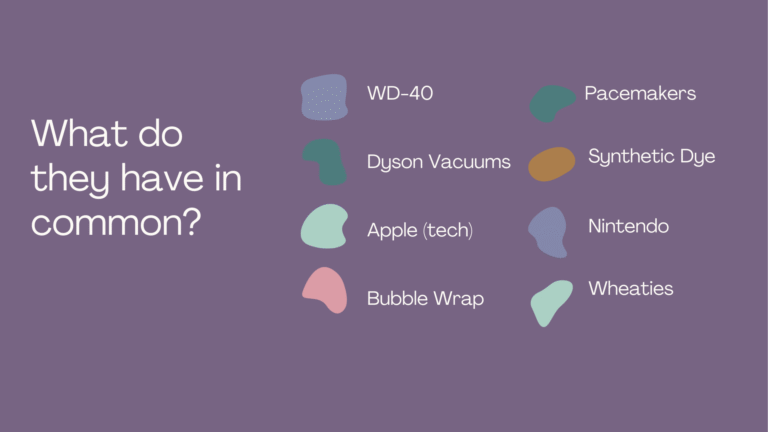
ɹǝʍsu∀ (Answer: Each of the signature products represented here was born from a mistake or series of failures. There would be no WD-40 without the 39 attempts that came before.)
What Does it Cost When Teams Don’t Feel Safe?
Have you ever been in a brainstorm where people threw out ideas freely until the best solution emerged? That’s what psychological safety feels like. It feels like anything’s possible and the outcome is better than anything any one person could’ve come up with alone.
Conversely, have you ever been in a brainstorm where ideas constantly got shot down or even mocked? Did you keep contributing? Did you feel at your creative best? Probably not.
So leaders, I ask you: What’s the cost of brilliant ideas that never get shared? What’s the cost of concerns not being raised before resources are poured into a project when those concerns end up being valid?
But you don’t have to believe me. Believe the researchers behind Project Aristotle, a major team effectiveness study at Google. They found:
“Psychological safety, more than anything else, was critical to making a team work.”
There were other factors, of course, but it’s almost like those couldn’t sprout without a soil bed of psychological safety.
While researching this post, I found plenty of articles linking collaboration to profitability, but I couldn’t find many concrete numbers. I did come across this, though: in a 2015 study Raconteur did for Google, 56% of respondents believed that successful collaboration had the greatest impact on company profitability.
So again I ask: What’s the cost of teams that don’t collaborate well?
I’m willing to bet it’s more than my fee, by a landslide. (Maybe I should charge more? 🤔)
Want to See What This Looks Like on Your Team?
On that note, I’m looking for a team that’s struggling to collaborate for a case study. If your team is stuck, reach out. I’m feeling generous this month. We can call it Collaboratability? Innovateful Teams? Or we can just use Amy Edmondson’s term: Fearless Organization, since you know, I’m certified.
What else would you like to know about psychological safety? What’s your experience of being in an environment with high levels of it? Low?
Resources
What People Get Wrong About Psychological Safety, Harvard Business Review, May/June 2025
What Google Learned From Its Quest to Build the Perfect Team, New York Times, Feb 2016
Collaboration is good for business, Alex Woodward, Raconteur, Oct 2015
Special shoutout to Ian at the Oakland Public Library for help getting access to one of these articles that the library doesn’t get digitally. Support your local libraries, y’all, they truly are one of the best community resources.