Executive Presence Feedback: What It Really Means and Why It's Often Biased
Feedback is a gift. That’s what I was supposed to embed in a manager training I was building for a famous/now infamous tech company. But like the last 3 you got from your Aunt Dorothy, sometimes “gifts” can be inappropriate and downright unusable. Today I want to talk about one of the worst offenders: executive presence.
My friend Roberta invited me to speak with her live in front of an audience for her podcast, In Her Words, and she asked me “what’s wrong with that term?” I answered, “everything” and we both laughed knowingly.
What Exactly is Executive Presence?
Honestly? Who knows? It’s a vague concept and I’m not sure I’ve seen anyone agree about what it actually means. In preparing for this post, I went looking for a definition. I stumbled onto a 2024 article from the Brown University School of Professional Studies that breaks it into 3 traits:
Appearance, which they define as dress, grooming, and body language.
Boldness, which they define as calm, courageous, and self-assured.
Communication, which they describe as “projecting” clearly and without filler words. Here’s their diagram about communication.
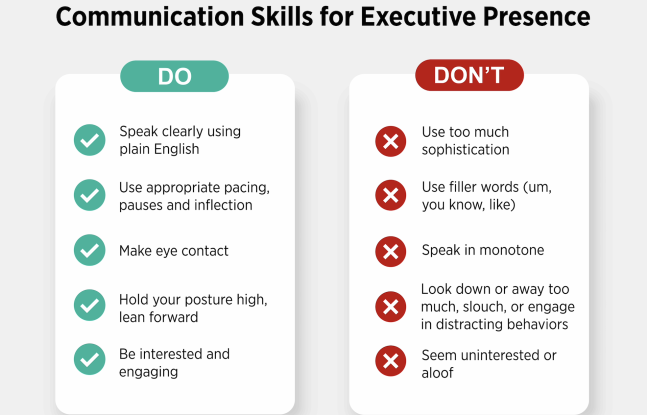
If you ask me, this definition is loaded and coded. In a world where only 31% of leaders are women and only 1% of leaders are Black women, I ask, what models do we have for what executive presence actually looks like?
Why This Definition Is Loaded and Coded
English Language Learners
If someone’s first language isn’t English, and it’s extra effort for them to “speak clearly using plain English,” or if they stumble or search for words, they might get discounted for not communicating with enough presence.
People with Neurodivergent Brains
As someone with a neurodivergent brain who provides therapy and coaching to people with neurodivergent brains, most items on this list make me want to scream.
People with neurodivergence might:
- Speak with little to no voice modulation
- Struggle to make eye contact
- Refrain from gesticulation
- Not express or vary emotion
- Have trouble keeping still
ADHD in the workplace is one of the most common presentations I see in my practice, and nearly every item on this list describes how an ADHD brain might naturally communicate. So what seems like simple coaching to you might actually be difficult, impossible, or threatening to them.
If you’re a neurodivergent professional navigating this kind of feedback, therapy can help you process it and figure out what to actually do with it.
People from Places or Families with Different Cultural Norms
Having lived and traveled in other countries, I can tell you that there are different norms around posture and eye contact than we have in the US. In some cultures, it would be disrespectful to give direct eye contact to someone of a higher status. Imagine criticizing someone for not showing executive presence when to them, they’re showing respect.
People with Physical Disabilities
Not every body works the same. If you criticize a person’s posture or how they hold themselves, you may be inadvertently showing ableism. You have no idea what pain they may be experiencing or what their bodies can and can’t do.
While I think the definition above is particularly archaic, I don’t think it’s that far off from an unspoken set of rules that some leaders hold as the gold standard.
In my other life, as a screenwriter, I hear advice from industry leaders that matches this all the time. At every workshop I’ve been to about pitching, the advice is always: be expressive, engaging, and entertaining. None of those are necessary to write a great script, and probably not to being a great addition to a writers’ room. For some people, it’s simply inaccessible.
Performance Review Bias Is Well-Documented
From 2022 to 2024, Textio analyzed performance reviews from over 25,000 employees and found these startling stats:
- Women receive 22% more feedback about their personality than men do. Women also receive 30% more exaggerated feedback than men.
- People under 40 report being described as “ambitious” 2.5x as often as people who are 40 and older.
- Asian people get more feedback than people of any other race, 25% more than white people.
- Black men receive 1/3 less feedback than white women on average, as measured by word count.
- Black women receive nearly 9x as much feedback that’s not actionable compared to white men under 40.
Because executive presence is unclearly defined and can be influenced by culture, personality, ability, and neurotype, there’s so much room for bias to creep in.
What I Wish Managers Would Do Instead
If you get nothing else from this article, please hear this:
Feedback is only useful when it’s objective.
And I mean the adjective and the noun.
Adjective: Here’s the test. If you win the lottery tomorrow and your direct report gets a new manager, the new manager should perceive the same thing. So, what did you see or hear?
“You raised your voice” is objective. “You got angry” is subjective.
Now, do you see why “have more executive presence” isn’t really helpful?
Noun: An example might be, “You have a goal of leading a team next year, and I noticed something that will help you move closer to that goal.” When the feedback is tied to something the receiver is already motivated towards, it actually becomes a gift, and they’re more likely to want to change their behavior.
When you keep things objective, you’re removing potential for bias. In your culture, family of origin, or general set of preferences, confidence might look like a person who dominates the conversation.
In my world, when I witness someone thoughtful enough to raise red flags, ask questions, allow silence, and admit when they don’t have an answer, that seems confident to me.
When I used to design manager training in-house for a tech company eleventy billion years ago, we taught the SBI model of feedback:
- Situation: context (at today’s team meeting)
- Behavior: what was observed (I noticed you weren’t able to give XYZ update)
- Impact: consequence (people are unsure whether XYZ is on track)
Pick whichever model you like, as long as you’ve covered those essentials and checked your own biases.
For a simple bias test, ask yourself, “If this were Tom Hanks, would I give him the same feedback?”
It might sound funny, but the essence of it is: would I give this same feedback to a white, cishet, older, well-respected male? And if you can’t imagine doing that, ask yourself whether this feedback is objective or simply your preference.
Of course, there may be an actual gift buried in the “executive presence” feedback.
You Can Grow Your Confidence
Maybe the person does doubt themselves in big moments, or struggles to make decisions, and that’s causing challenges for the team.
As I said on In Her Words:
“I’m never going to teach a woman how to be more aggressive in the workplace.”
I also won’t teach her to be someone she’s not.
But I will help people grow their confidence, especially in moments that matter. I will help people process the double standard and feel empowered to stay true to themselves despite bias and difficult workplace cultures. By the time people reach out to me, they’re often exhausted from masking and burned out from trying to be someone they’re not.
Stay tuned for Part 2, where I go deeper into what to actually do when you receive feedback like this.
Does your organization want to give useful gifts?
If your managers don’t want to be like Aunt Dorothy and would like help giving better feedback, let’s talk.
Or maybe you’d like to cultivate a more neuroaffirming culture. You know where to find me.
And if you’re exhausted or burned out from being told you need more executive presence, or otherwise need help dealing with challenging feedback, that’s what Part 2 is about. Reach out if you’d like individual support before then.
About the author:
Megan Rees, LPCC, is a therapist specializing in work stress, burnout, and ADHD in Oakland and across California. She also provides coaching to people who are seeking the confidence to try something new with their current world of work, and consulting to companies looking to uplevel their collaboration and build more neuroaffirming environments.
Resources:
Listen to the Playing Small episode of In Her Words or watch on YouTube
Textio’s report: Language Bias in Performance Feedback
Brown University School of Professional Studies, The ABCs of Executive Presence